ATLAS: Agent Tuning via Learning Critical Steps
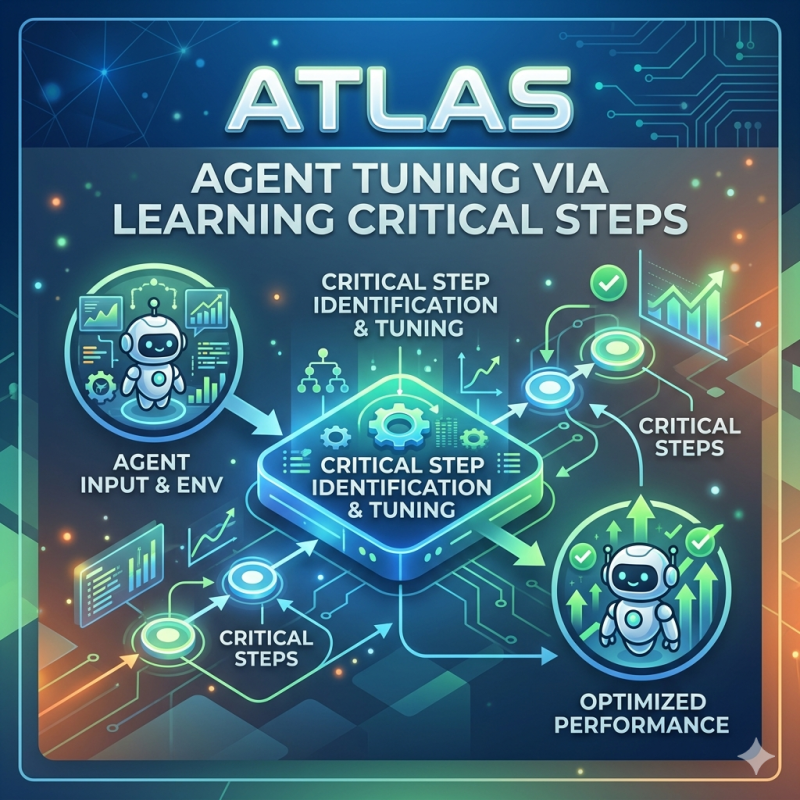
ATLAS: Agent Tuning via Learning Critical Steps.
Research question
The paper asks whether LLM agents can be fine-tuned more effectively by learning only from the most important steps in expert trajectories rather than imitating every step. More specifically, it studies whether focusing training on “critical steps” can reduce expert bias, lower training cost, and improve generalization to unseen tasks and environments.
Methodology
The authors propose ATLAS, a step-selection approach in which an oracle LLM, GPT-4o by default, identifies critical steps in expert trajectories using four criteria: key observations, plan formulation, recalling prior information, and pivotal actions. The base model is then fine-tuned only on those selected steps, and the method is evaluated across multiple interactive environments and compared with full-trajectory tuning, non-critical-step tuning, and random step selection at different ratios.
Findings
The paper finds that training on about 30% of trajectory steps works best and can outperform training on complete expert trajectories, with the reported averages rising from 60.52 to 65.91 on held-in tasks and from 36.18 to 38.36 on held-out tasks. It also shows that critical-step tuning beats random step selection and non-critical-step tuning, suggesting that the gain comes from selecting informative steps rather than simply using fewer tokens.
Limitations
A main limitation is that the critical-step selector depends heavily on a strong closed-source model, which raises cost and reproducibility concerns. The authors also note that their current selection procedure is mainly semantic, and suggest that combining it with other metrics could improve the precision of step selection and reduce the number of tokens needed even further.
Why it’s important
This paper matters because it challenges the assumption that more imitation data is always better for agent tuning, showing that selective supervision can improve both efficiency and generalization. More broadly, it offers a practical framework for training agents that learn the hardest and most consequential decisions without overfitting to every detail of expert behavior.